LATIN NAME
Acer negundo
OTHER NAMES
Name(s) in English:
Box elder, Manitoba Maple, Ash-Leafed Maple 1
Name(s) in Ojibwe(Anishinaabemowin):
Although some sources refer to the Manitoba maple as adjagobi’mak in Anishinaabemowin. 3
Name(s) in French:
Érable du Manitoba, Érable à Giguère, 4 Érable à feuilles composées. 5
Name(s) in Cree:
Sesipâskwatâhtik 6
Name(s) in Michif:
Araab manitobah 6
Name(s) in Dakota:
TBD*
* Know the name? Know another word for the same plant not listed above? We’d love to hear about it! Please add in the comments below along with any info that might help, such as links, dialect, area you are from, where you heard it.
BIOLOGICAL INFORMATION
Plant Type
Deciduous tree 7
Habitat
Found in riverbanks, stream beds, lakeshores, disturbed lands, open areas. 8
Zone
2 to 9 9
How to Identify the Species
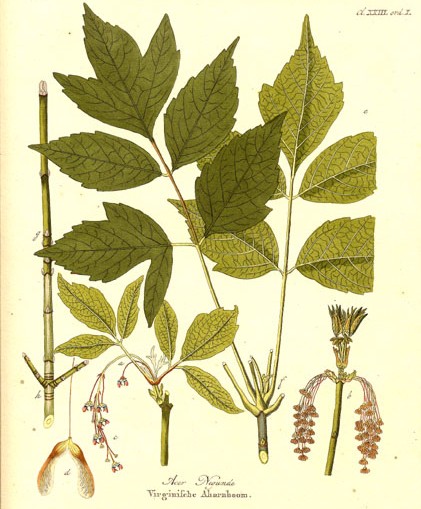
Flowers: small yellow-green flowers appear in spring. The flowers are not very showy because the tree is wind pollinated. 6
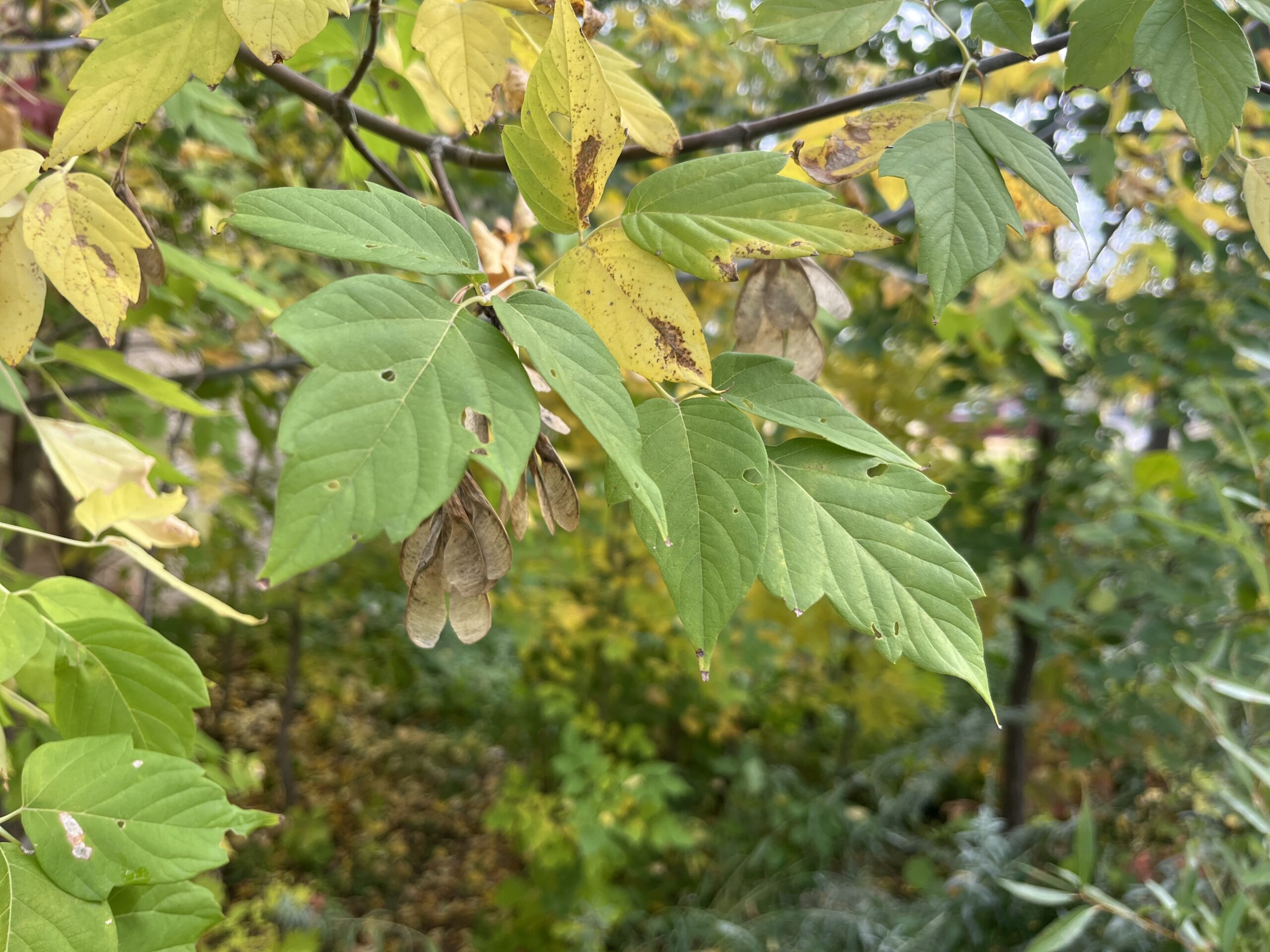
Leaves: compound, meaning one leaf is made of multiple smaller leaflets. Manitoba Maple leaves usually have 3–5 leaflets. Baby leaves have red tips which turn green over time. 6
Seeds: female trees produce paired winged samaras. These form from summer to fall (some stay on the tree into winter). 10
Branches: opposite to each other, smooth, green when young and then becomes grey or even black. 6
What to Look For
Winged samaras (seeds)
A leaf made of 3-5 leaflets
Small yellow-green flowers in early spring
Indigenous context
– The pillager ojibwe people collected the sap and mixed it with regular sugar maple sap to drink as a beverage. 11
– The inner bark of the Manitoba Maple was used by the Great Lakes Ojibwe peoples to induce vomiting. 12
– The Dakota and Omaha people made the wood into charcoal, which is used in ceremonial painting and tattooing. 13,11
– The sap of the Manitoba Maple has been used to make syrup by multiple indigenous populations of North America including the Dakota, Cree, Sioux, and Omaha amongst others. 13
Interesting or unique facts about this species
– Manitoba Maple seeds are often called “Helicopter seeds” because they spin as they fall to the ground. 6
– Manitoba maple was identified as the material used in the oldest extant wood flutes, discovered in 1931 in Northeastern Arizona and dated to 620-670 CE. 13
– Manitoba Maple is the only Maple native to Canada with compound leaves. 14
– Manitoba Maples are considered Invasive in Ontario. 15
STRUCTURE
Height at Maturity
10-20 meters 16
Canopy Spread
9-15 meters 17
OTHER INFORMATION
Soil Type
The Manitoba Maple tolerates drought and flooding conditions, and can grow in solid from sandy loam to clay. However it prefers a neural pH around 6.5-7.5 and can tolerate slightly acidic soils with a pH as low as 5. 18
Sun Conditions
Grows best in sunny conditions and tolerates partial shade 16
Watering
Manitoba maple can tolerate a wide range of watering conditions from dry to very wet and is quite drought hardy once established due to its favoured habitat in floodplains. It is a very tough tree that can withstand neglect, potting and disturbed soils. 19
Seed Collection
The helicopter seeds/ samaras are ripe and ready to collect at the end of the summer/ beginning of the fall from August to September. 18
Growing Manitoba Maple from seed
The mature samaras collected in the fall, can be sown outdoors to experience winter conditions and germinate the upcoming spring. 20 For spring sowing, then we would have to imitate the natural conditions through cold stratification around 0-5℃ for 60-90 days in a moist medium. 21After that, the seed can then be planted in appropriate soil and sun conditions which will allow the seeds to germinate in approximately 2-7 weeks. 22 Although germination time may vary, considering factors such as seed size and the duration of cold stratification. 23
- Native Plant Trust. (n.d.). Acer negundo—Ash-leaved maple, boxelder. Go Botany. https://gobotany.nativeplanttrust.org/species/acer/negundo/[↩]
- Roger Roulette for Winnipeg Trails, 2021[↩]
- Meeker, J. E., Elias, J. E., & Heim, J. A. (1993). Plants used by the Great Lakes Ojibwa. Great Lakes Indian Fish and Wildlife Commission. https://www.miinojibwe.org/wp-content/uploads/2025/07/Plants-1.pdf.[↩]
- Office québécois de la langue française. (1995). Érable négondo. Grand dictionnaire terminologique, Vitrine linguistique. https://vitrinelinguistique.oqlf.gouv.qc.ca/fiche-gdt/fiche/18493418/erable-negondo[↩]
- Association forestière du sud du Québec. (n.d.). Érable à feuilles composées. https://www.afsq.org/fr/erable-a-feuille-composees[↩]
- Government of Manitoba. (n.d.). Trees of Manitoba field guide. https://www.gov.mb.ca/nrnd/forest/pubs/forest_lands/field_guide.pdf[↩][↩][↩][↩][↩][↩]
- University of British Columbia. (n.d.). Acer negundo L. E-Flora BC: Electronic Atlas of the Flora of British Columbia. https://linnet.geog.ubc.ca/Atlas/Atlas.aspx?sciname=Acer%20negundo[↩]
- Natural Resources Canada. (n.d.). Manitoba maple. Tree information factsheet. https://tidcf.nrcan.gc.ca/en/trees/factsheet/81[↩]
- Natural Resources Canada. (n.d.). Acer negundo [Plant hardiness map]. Canada’s Plant Hardiness Site.https://planthardiness.gc.ca/index.php?phz=p31898661971-2000&s=m&speciesid=3189866&m=7&lang=en#[↩]
- Simkovic, V. (2024). Manitoba maple (Acer negundo): Best management practices in Ontario. Ontario Invasive Plant Council. https://www.ontarioinvasiveplants.ca/wp-content/uploads/2024/10/OIPC_BMP_ManitobaMaple_Oct282024_D6_FINAL_WEB.pdf [↩]
- Smith, H. H. (1932). Ethnobotany of the Ojibwe Indians. Bulletin of the Public Museum of the City of Milwaukee, 4(3), 327–525. https://blogs.nwic.edu/briansblog/files/2013/02/Ethnobotany-of-the-Ojibwe-Indians.pdf[↩][↩]
- Meeker, J.E, Elias, J.E, & Heim, J. A. (1993). Plants used by the Great Lakes Ojibwa. Great Lakes Indian Fish and Wildlife Commission. https://www.miinojibwe.org/wp-content/uploads/2025/07/Plants-1.pdf [↩]
- Naturalist. (n.d.). Box elder (Acer negundo). Retrieved from https://www.inaturalist.org/taxa/47726-Acer-negundo[↩][↩][↩]
- University of Guelph Arboretum. (n.d.). Manitoba maple. https://arboretum.uoguelph.ca/thingstosee/trees/manitobamaple[↩]
- Simkovic, V. (2024). Manitoba maple (Acer negundo): Best management practices in Ontario. Ontario Invasive Plant Council. https://www.ontarioinvasiveplants.ca/wp-content/uploads/2024/10/OIPC_BMP_ManitobaMaple_Oct282024_D6_FINAL_WEB.pdf[↩]
- Overton, R. P. (1990). Boxelder. In Silvics of North America. U.S. Department of Agriculture, Forest Service. https://research.fs.usda.gov/silvics/boxelder[↩][↩]
- Missouri Botanical Garden. (n.d.). Acer negundo. Plant Finder. https://plantfinder.mobot.org/PlantFinderDetails.aspx?kempercode=a841[↩]
- Koetter, R., & Zuzek, K. (2026). Boxelder. University of Minnesota Extension. https://extension.umn.edu/garden-and-home/yard-and-garden/lawns-and-landscapes-in-minnesota/trees-and-shrubs/boxelder[↩][↩]
- Rosario, L. C. (1988). Acer negundo. Fire Effects Information System. U.S. Department of Agriculture, Forest Service, Rocky Mountain Research Station, Fire Sciences Laboratory. https://www.fs.usda.gov/database/feis/plants/tree/aceneg/all.html[↩]
- Vanstone, D. E., Ronald, W. G., & Marshall, H. H. (1982). Nursery propagation of woody and herbaceous perennials for the Prairie Provinces (Publication 1733E). Agriculture Canada.https://publications.gc.ca/collections/collection_2015/aac-aafc/A53-1733-1982-eng.pdf[↩]
- Nesom, G. (2006). Boxelder: Acer negundo L. [Plant guide]. U.S. Department of Agriculture, Natural Resources Conservation Service. https://plants.sc.egov.usda.gov/DocumentLibrary/plantguide/pdf/pg_acne2.pdf[↩]
- Bonner, F. T., & Karrfalt, R. P. (Eds.). (2008). The woody plant seed manual (Agriculture Handbook No. 727). U.S. Department of Agriculture, Forest Service. https://www.fs.usda.gov/nsl/Wpsm/Acer.pdf[↩]
- Kiseleva, O. A., Loretts, O. G., & Veselkin, D. V. (2020). Seed size and cold stratification affect Acer negundo and Acer ginnala seeds germination. Agronomy Research, 18(2), 461–471.https://dspace.emu.ee/server/api/core/bitstreams/4f750d69-3a6d-4c45-a2cb-a4748d91207a/content[↩]